

DIY Dent Repair Kits: Do They Actually Work?
DIY dent repair kits can improve the appearance of very minor, shallow dents under ideal conditions. In most real-world cases, however, they produce partial results at best and can cause new problems – including paint damage and metal over-stretching – that make the eventual professional repair more expensive. Understanding what these kits can and cannot do helps you avoid a costly mistake.
What DIY Kits Are Available
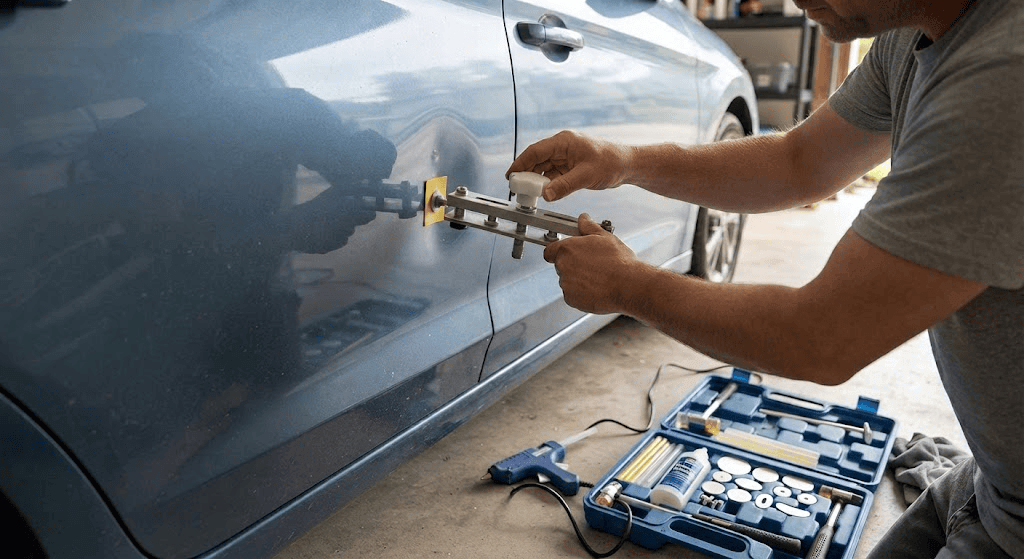
The most common DIY dent repair options are suction cup pullers, glue tab systems (similar in concept to professional GPR but with much lower quality materials and control), and hot water or hair dryer techniques for plastic bumpers. Suction cups are sold at most motor accessory shops and online for between £10 and £50. More elaborate glue tab systems are available for £30-£100.
What They Can Achieve
A good-quality suction cup can sometimes partially lift a shallow, round dent on a flat panel section. The word 'partially' is important here: these tools apply uncontrolled, uniform force across the dent, which is the opposite of the careful, targeted pressure that a PDR technician applies. The result is often an improvement in appearance but with a raised centre, irregular shape, or subtle distortion that remains visible in certain lighting conditions.
The Risks of DIY Attempts
Over-pulling a dent is a significant risk with DIY glue tab systems. Pulling too hard or in the wrong direction can cause the metal to rise above its original level – a high spot – which is actually harder to correct than the original dent because it requires pushing the metal back down from outside the panel. High spots require specialist tools that most DIY kits do not include.
Paint damage is another risk. Aggressive suction or poorly prepared glue tab adhesive can damage or lift the paint, particularly on older vehicles or in cold weather conditions. Once the paint is damaged, PDR alone cannot produce a perfect result, and a conventional paint repair is required.
Why Professional PDR Produces Better Results
Professional PDR uses purpose-built rods, levers, and controlled lighting to address dents incrementally and precisely. The technician can see exactly how the metal is responding to each movement and adjust accordingly. This level of control is simply not achievable with a consumer product. The difference in outcome is consistently significant.
When DIY Makes Sense
The only scenario where a DIY attempt is genuinely low-risk is a very shallow, round dent on a flat panel section of a low-value car where cosmetic appearance is not a priority. In all other cases – anything on a character line, anything on a prestige car, anything on an EV or aluminium-bodied vehicle – professional PDR from the outset produces a better result and avoids the risk of compounding the damage.
Get a Free Quote
Text a clear photo of the dent to 07824426591 with your vehicle make and model. Graham will reply the same day with an honest price.
Related guides
Which Dents Can Be Fixed with Paintless Dent Repair? →
Related Questions
What is paintless dent repair?
Paintless dent repair (PDR) is a method of removing dents, dings, and creases from a vehicle's bodywork without the need for paint, filler, or replacement panels. A trained technician uses specialist tools to massage the metal back to its original shape from behind the panel, preserving the factory paint finish entirely.
Is paintless dent repair as good as traditional bodywork?
For dents where the paint is undamaged, PDR produces results that are equal to or better than traditional bodywork. There is no risk of colour mismatch, no filler that can crack or shrink over time, and no repainting that could diminish the factory finish. PDR preserves the original paint, which is always preferable from a quality and resale value standpoint.
Do you guarantee your work?
Yes. All repairs carried out by Dent Detail PDR are guaranteed. If you are not completely satisfied with the result at the time of completion, the issue will be addressed before the job is signed off. Graham's approach is straightforward: if the repair cannot be completed to the required standard, that is stated clearly before work begins, not after.
Recent Comments